Trying to pick between a condo and a townhome in downtown St. Pete? You are not alone. In a walkable, waterfront city center with lots of high-rises and new development, the right choice comes down to how you prefer to own, maintain, and use your home. In this guide, you will compare costs, rules, insurance, financing, and lifestyle tradeoffs so you can buy with confidence. Let’s dive in.
Condo vs. townhome basics
What a condo means in Florida
A condominium gives you individual ownership of your unit and a shared interest in the common areas. It is governed by the Florida Condominium Act, found in Chapter 718 of state law. The association usually holds a master insurance policy for the building and common elements. You will likely carry an HO-6 policy for your interior and personal property.
What a townhome can mean here
“Townhome” can describe two different legal setups in Florida. You may see a fee-simple townhome that you own from the ground up, often under a homeowners association that manages shared areas. You may also see a townhome-style condominium that functions like a condo for insurance and maintenance. If it is fee-simple, Chapter 720 of Florida law typically applies. Always confirm if the townhome is fee-simple or a condo regime.
Ownership and legal structure
What you own and maintain
- Condo: You own the interior airspace of your unit plus a share of common elements. The association maintains the exterior, roof, and shared systems, as spelled out in the declaration and bylaws.
- Fee-simple townhome: You usually own the structure and the land under it. You maintain your roof, exterior, and any private yard or driveway, while the HOA handles shared landscaping, roads, or gates.
Downtown St. Pete context
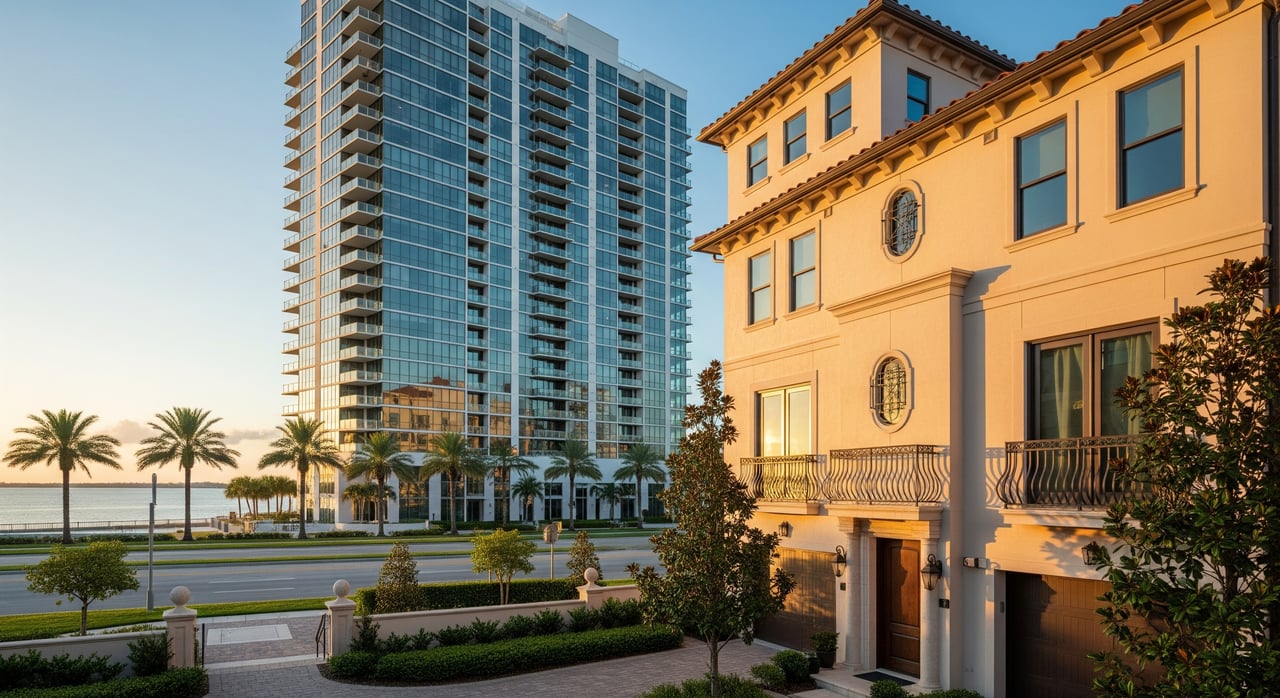
Downtown St. Petersburg is a dense, walkable core with many mid- and high-rise condominium buildings. Townhomes do exist but are less common in the heart of downtown. You will see more townhome options on the edges of downtown and in nearby areas like the Edge District, the Warehouse Arts District, and Old Northeast. Zoning drives this pattern because the central business district supports taller, mixed-use buildings.
Maintenance and insurance
Who handles exterior and systems
- Condos: The association typically handles the exterior, roof, elevators, lobbies, and common HVAC. This lowers your day-to-day maintenance but often comes with higher monthly dues.
- Fee-simple townhomes: You are usually responsible for exterior items and the roof. The HOA fee is often lower because you handle more of the maintenance directly.
Your insurance policy type
- Condos: Most owners carry an HO-6 policy for interiors, finishes, and personal property. The master policy covers common elements. Ask for the master policy and note the deductible, because unit owners may share in that deductible during a claim.
- Fee-simple townhomes: Many owners carry a full dwelling policy, such as HO-3, since they own the exterior and the roof.
Flood and wind considerations
Parts of downtown St. Pete lie in FEMA flood zones. If a property sits in a Special Flood Hazard Area and you use a federally regulated mortgage, flood insurance is often required. Many owners also carry wind or combined wind and hazard coverage, which can vary by building and underwriting. Always confirm flood zone, elevation, and insurance requirements before you write an offer.
Monthly fees and total cost
What HOA and condo fees cover
Condo dues often include building exterior, roof, elevators, security, trash, water and sewer in some buildings, common-area HVAC, and amenities such as a pool or gym. Townhome dues often cover shared landscaping, private road or gate maintenance, and reserves for those shared items. Always request the most recent budget and reserve study so you know what is included and how well the association is funding long-term repairs.
Special assessments and reserves
Older condominium buildings in Florida have sometimes faced special assessments for major repairs. After the 2021 Surfside collapse, buyers are more focused on reserves, structural reports, and long-term maintenance planning. Strong reserves reduce the risk of large, unexpected bills, so review the reserve study and recent board meeting minutes to see what projects are planned or underway.
Taxes and comparisons
Use the Pinellas County Property Appraiser records for estimated taxes and assessments. For an apples-to-apples comparison of monthly costs, add mortgage, taxes, insurance, and HOA or condo fees. Then weigh any included utilities and amenities against the maintenance you would handle in a fee-simple townhome.
Safety, inspections, and reserves
What to request from the association
Ask for the reserve study, recent financial statements, and board meeting minutes from the last 12 to 24 months. If available, review any engineering or structural inspection reports, especially for older buildings. Confirm if major projects are planned, funded, or recently completed.
How to check permits and work history
You can review City of St. Petersburg building permit history for major projects such as roof replacement, concrete restoration, and mechanical upgrades. Also request documentation on special assessments and whether they are paid in full or will transfer at closing.
Financing differences
Condo project approval
Some loan programs require project approval for condominiums. This can affect FHA and VA loans and some conventional options. If you plan to use one of these loans, verify project approval early. Project status can influence down payment options or mortgage insurance requirements.
Townhomes and underwriting
Fee-simple townhomes are often underwritten like single-family homes, which can simplify the process. Lenders still review the HOA’s financial health and insurance, but they may not require a condo project approval. If the townhome is a condo structure, the condo rules apply.
Rental and short-term rental rules
Association restrictions
Many condos and HOAs have rental caps, minimum lease terms, and registration or approval procedures. Some restrict short-term rentals. If you plan to rent, review the declaration, rules and regulations, and application process to avoid surprises.
City requirements
The City of St. Petersburg has local rules for rentals, including short-term rentals in certain areas. These rules work together with any association restrictions. Confirm both before you buy if rental income is part of your plan.
Lifestyle tradeoffs downtown
Privacy and space
Townhomes often deliver private entries, multiple floors, and attached garages. Some include small yards or patios. Condos can provide efficient single-level living, which is useful if you prefer elevator access and minimal maintenance.
Amenities and walkability
Condos shine when you want amenities such as a fitness center, a pool, or security and a front desk. Many buildings sit close to restaurants, cultural venues, and waterfront parks. Townhomes may have fewer community amenities but more private space.
Parking and access
Downtown condos often come with assigned or covered parking, sometimes for an extra fee. Townhomes commonly offer private garages or driveways. Consider guest parking, bike storage, and EV charging if those matter to you.
Quick decision guide
Choose a condo if you want:
- Minimal exterior maintenance and a lock-and-leave setup.
- On-site amenities like a pool, gym, or security.
- A walkable location in the heart of downtown.
Choose a townhome if you want:
- Fee-simple ownership and more control over the property.
- A private entry, attached garage, or outdoor space.
- Lower monthly HOA dues in exchange for handling more maintenance.
Buyer due diligence checklist
Gather these documents before you commit:
- Declaration, bylaws, articles, and rules and regulations.
- Association budget, recent financials, and the most recent reserve study.
- Insurance certificate for the association, including master policy details and deductibles.
- Board meeting minutes from the last 12 to 24 months.
- List of recent or pending special assessments and major repairs.
- City building permit history for major projects.
- Flood zone designation and insurance quotes.
- Clarification of utilities included in monthly fees.
- For townhomes: proof of fee-simple or condominium title and any road or shared-maintenance obligations.
Ask these questions:
- What is the ratio of owner-occupied to rented units?
- Are there any pending lawsuits involving the association?
- How many owners are delinquent on dues?
- Have there been special assessments in the last 5 to 10 years, and are any planned?
- When was the reserve study last updated?
- What repairs is the unit owner responsible for?
- What are the rental rules and any city permitting requirements?
How to choose with confidence
Start with your nonnegotiables. Decide how much maintenance you want, whether amenities are must-haves, how important a private garage is, and how you plan to finance. Then compare total monthly costs, insurance, and reserves. In downtown St. Pete, condos dominate the urban core and offer convenience and amenities, while townhomes can deliver private space and fee-simple control when available nearby.
If you want a clear strategy, a thorough document review, and practical insight into building conditions and resale potential, connect with a local advisor who knows both the market and construction. For hands-on guidance from search to closing, including help coordinating financing, insurance quotes, and association due diligence, reach out to Derek Mcdonald.
FAQs
What is the main legal difference between a condo and a townhome in Florida?
- A condo is governed by Chapter 718 and gives you unit ownership plus shared common elements, while a fee-simple townhome is often governed by Chapter 720 and you typically own the structure and land.
How do HOA or condo fees compare in downtown St. Pete?
- Condo fees are often higher because they cover exterior, roof, shared systems, and amenities, while fee-simple townhome fees tend to be lower since you handle more maintenance.
What insurance will I need for each type?
- Condo owners usually carry an HO-6 policy for interiors and personal property, while fee-simple townhome owners often carry a full dwelling policy such as HO-3.
Are special assessments more common in condos?
- Older condominium buildings in Florida have sometimes faced significant assessments for major repairs, which is why reserve studies and recent board minutes are essential.
Will flood insurance be required downtown?
- It depends on the flood zone and your lender; properties in a FEMA Special Flood Hazard Area with federally regulated mortgages typically require flood insurance.
Is financing easier for condos or townhomes?
- Fee-simple townhomes are often underwritten like single-family homes, while condos may need project approval for certain loan programs, so verify early with your lender.
Can I use a condo or townhome for short-term rentals?
- Possibly, but both the association rules and City of St. Petersburg regulations may restrict or require registration, so confirm both before buying.